
Heated Clothes Airer vs Dehumidifier vs Tumble Dryer: UK Running Costs & Condensation
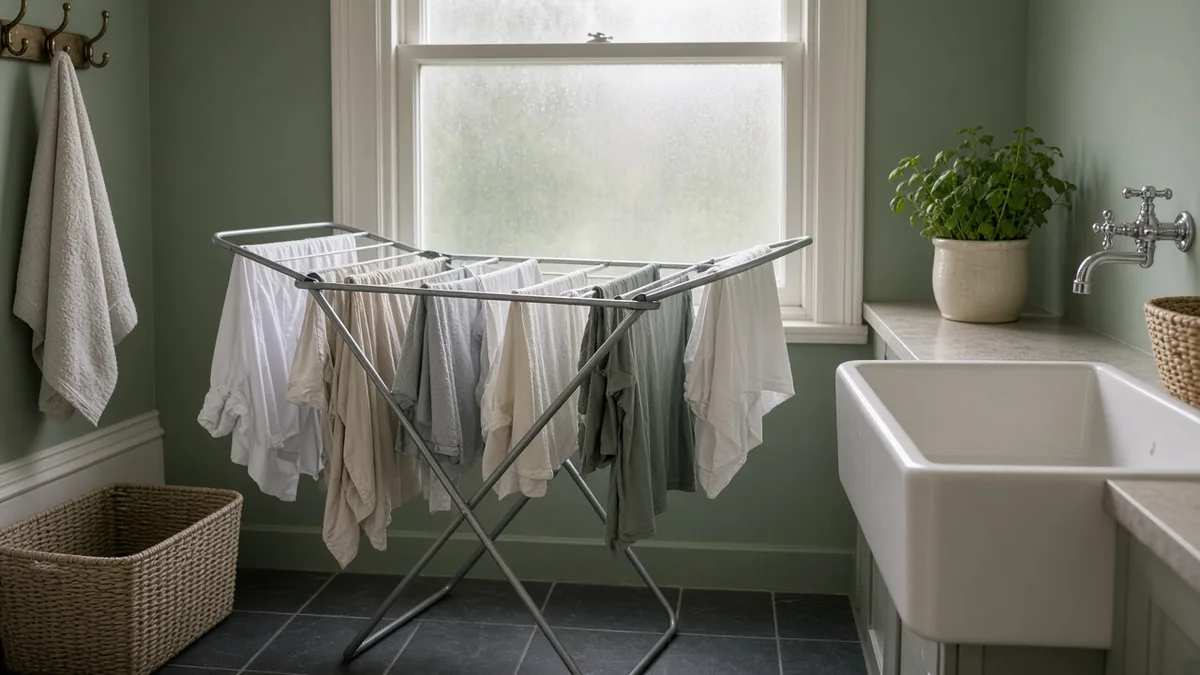
A 198 W to 300 W heated clothes airer costs 5.21p to 7.90p per hour at the Ofgem Q4 2026 cap of 26.32p/kWh (£0.42 to £0.63 for an 8-hour session), while a 155 W–230 W compressor dehumidifier costs 4.08p to 6.05p per hour (£0.33 to £0.48 for 8 hours). Unlike a heated airer alone—which releases all laundry moisture into the room air—a dehumidifier captures that water in a tank, and pairing both gives fast winter drying without window condensation.
Between October and April in Britain, outdoor line drying becomes unpredictable, and households quickly face an awkward three-way choice: buy a heated clothes airer, run a dehumidifier next to an ordinary drying rack, or rely on a tumble dryer.
Each method solves a slightly different problem. A heated airer applies gentle contact warmth directly to fabric, a tumble dryer tumbles clothes in heated air inside a drum, and a dehumidifier physically pulls evaporated water vapour out of the room air into a bucket. Getting the choice wrong—especially in a small one-bedroom flat or Victorian terrace—either sends your electricity bill soaring or leaves wet washing moisture condensing on cold bedroom walls.
What Each Appliance Actually Does to Moisture and Energy
Before comparing pounds and pence, it helps to separate heating clothes from removing water:
- Heated clothes airers (198 W – 300 W): Aluminium bars warm up gently, accelerating evaporation from wet shirts, towels, and socks. However, 100% of the water in your washing still enters the room air as vapour. That is why Energy Saving Trust's Energy Savers Week guidance explicitly reminds households using heated airers to keep trickle vents or a window open, or pair the airer with a dehumidifier.
- Compressor dehumidifiers (151 W – 230 W typical): A dehumidifier does not heat clothes directly; instead, it lowers the room's relative humidity so wet fabric evaporates faster into dry air while capturing the extracted water inside a 2L–4.8L tank. Your windows stay clear and the room does not feel clammy.
- Tumble dryers (vented, condenser, or heat-pump): Vented dryers blow moist air outside through a ducted hose; condenser and heat-pump dryers condense moisture into an internal drawer or drain. As Energy Saving Trust notes on home appliances, older B-rated vented or condenser machines consume heavy bursts of electricity compared with modern A+++ heat-pump dryers—saving around £700 in Great Britain (and £850 in Northern Ireland) over a 13-year appliance lifespan when moving from B-rated to A+++. They also require floor space, plumbing/venting, and far higher upfront outlay (£400–£800+ for efficient heat-pump units) than a £105–£200 airer or dehumidifier.
Side-by-Side Running Cost Comparison (Ofgem Q4 2026 Cap, 26.32p/kWh)
Using exact published wattages from our UK dataset, here is how an 8-hour overnight or daytime indoor drying session compares at the Ofgem Q4 2026 average Direct Debit unit rate of 26.32p/kWh — the default used by every calculator on this site:
| Setup (In-Stock UK Examples) | Power Draw | Cost / hr @ 26.32p | 8h Session @ 26.32p | Where Moisture Goes |
|---|---|---|---|---|
| MeacoDry Arete One 12L | 151 W | 3.97p | £0.32 | Captured in 2.5L tank |
| MeacoDry Arete Two 12L | 155 W | 4.08p | £0.33 | Captured in 2.5L tank |
| Lakeland Dry:Soon Mini 3-Tier Airer | 198 W | 5.21p | £0.42 | Released into room air |
| Pro Breeze OmniDry 12L | 200 W | 5.26p | £0.42 | Captured in 2.0L tank |
| MeacoDry Arete Two 20L | 230 W | 6.05p | £0.48 | Captured in 4.8L tank |
| Lakeland Dry:Soon Standard 3-Tier Airer | 300 W | 7.90p | £0.63 | Released into room air |
| BLACK+DECKER 3-Tier Heated Airer | 300 W | 7.90p | £0.63 | Released into room air |
| Paired: Dry:Soon Mini (198 W) + Arete Two 12L (155 W) | 353 W | 9.29p | £0.74 | Captured in 2.5L tank |
| Paired: 300 W 3-Tier Airer + Arete Two 20L (230 W) | 530 W | 13.95p | £1.12 | Captured in 4.8L tank |
Look closely at the paired setup figures. Running a 198 W mini heated airer and a 155 W 12L compressor dehumidifier together in a closed spare room draws 353 W combined—just £0.74 for an 8-hour overnight dry at 26.32p/kWh. Even a full-size 300 W 3-tier airer paired with a 230 W 20L dehumidifier costs £1.12 for 8 hours, and in practice a paired setup often finishes lighter cottons in 4 to 6 hours rather than needing the full 8.
The Condensation Trap: Why Drying on Radiators or Unventilated Airers Backfires
In a well-insulated British home—or worse, a solid-wall Victorian terrace with cool outer masonry—indoor washing is one of the single biggest daily spikes in moisture load. As Energy Saving Trust's damp and condensation guide highlights, excess vapour condenses as soon as it reaches cold glass, window reveals, or walls behind furniture.
Two common winter habits make things worse:
- Draping wet jeans and towels directly over central heating radiators: Covering a radiator panel blocks room convection, forcing your boiler or heat pump to run longer to satisfy the room thermostat while simultaneously evaporating litres of water straight into cold bedroom air.
- Zipping a heated airer cover shut in an unventilated lounge without a dehumidifier: A cover traps warm air inside the rack so shirts dry faster, yet the damp air still escapes through the top vent slits and bottom hem into your living room. If you use a heated airer with a cover in a room without strong cross-ventilation, place a dehumidifier beside the airer or open a window and close the internal room door.
Which Combination Suits Different UK Homes?
1. One-Bedroom or Studio Flats (Tight Space, No Utility Room)
A bulky 300 W airer plus a 20L compressor can eat up half a living room. A compact 12L compressor dehumidifier (such as the 155 W MeacoDry Arete Two 12L or 200 W Pro Breeze OmniDry 12L) paired with an ordinary foldable clothes horse—or the smaller 198 W Lakeland Dry:Soon Mini 3-Tier—keeps condensation off bedroom windows and folds away neatly after drying. Because many studio flats do not have a separate drying room, keep noise below 36 dB if running overnight.
2. Three-Bedroom Family Homes With Frequent Towel & Bedding Loads
If you wash four or more heavy loads a week, capacity matters. A 300 W 3-tier heated airer (such as the Lakeland Dry:Soon Standard/Deluxe or BLACK+DECKER 3-Tier) handles long sheets and jeans cleanly, while a 20L compressor dehumidifier (such as the 230 W MeacoDry Arete Two 20L with its 4.8L tank) prevents a full family wash from dripping down upstairs window sills.
3. Cold Utility Lean-Tos and Unheated Conservatories
Most compressor dehumidifiers slow down sharply below 10°C–15°C. If your laundry rack sits in an unheated utility porch or cold conservatory, choose a 1°C-rated desiccant dehumidifier (like the 231 W Meaco DD8L Pro) or move the airer into a heated indoor room with the door closed.
4. Households That Already Own an A+++ Heat-Pump Tumble Dryer
Keep using your heat-pump dryer for bulky towels and cotton bedding, and save a foldable airer plus dehumidifier for wool jumpers, delicates, waterproof coats, and everyday condensation control around bathrooms and windows.
Practical Checklist for Faster, Cheaper Indoor Drying
- Use your washing machine's highest suitable spin speed: Running a 1400 rpm or 1600 rpm spin extracts far more liquid water mechanically in minutes than an airer or dehumidifier can evaporate in hours.
- Close the drying room door: Never try to dehumidify your entire house while drying laundry; shut the spare room or utility door so the dehumidifier drops RH quickly in that single volume of air.
- Space garments out: Overlapping T-shirts on heated rails create cold damp pockets. Leave at least a finger's width between items and flip thick jeans pockets halfway through.
- Check outdoor drying opportunities first: As Energy Saving Trust notes, dry overcast breezy days can still dry clothes outdoors for £0—even a few hours outside removes most of the water before finishing indoors.
Recommended In-Stock Models & Running Costs
Only models currently in stock on Amazon UK are shown below. Adjust the electricity rate to match your tariff.
| Model | Category | Power | Cost / hr | 8h Cycle | Amazon UK Price | Action |
|---|---|---|---|---|---|---|
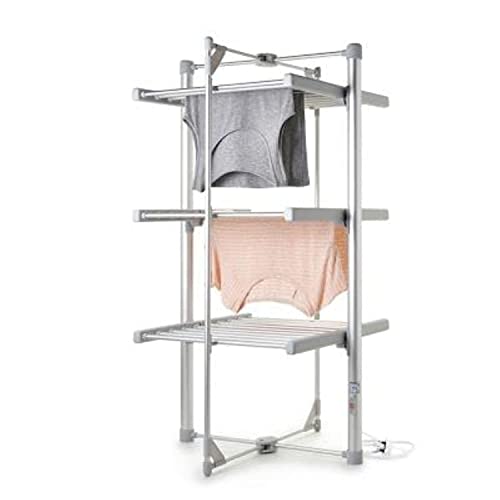
| Heated Airers | 198 W | 5.21p/hr | £0.42 | £104.97 90-DAY LOW Price accurate as of 28/11/2026 04:49 GMT | Check price on Amazon | |
| Heated Airers | 300 W | 7.90p/hr | £0.63 | £119.97 90-DAY LOW Price accurate as of 28/11/2026 04:49 GMT | Check price on Amazon | |
| Heated Airers | 300 W | 7.90p/hr | £0.63 | £118.99 90-DAY LOW Price accurate as of 28/11/2026 04:49 GMT | Check price on Amazon | |

Meaco MeacoDry Arete Two 12L Dehumidifier / Air Purifier
12L/day
·
35 dB
|
Compressors | 155 W | 4.08p/hr | £0.33 | £199.99 90-DAY LOW Price accurate as of 28/11/2026 04:49 GMT | Check price on Amazon |

Pro Breeze OmniDry 12L Quiet Dehumidifier with Max Extraction
12L/day
·
36 dB
|
Compressors | 200 W | 5.26p/hr | £0.42 | £118.99 90-DAY LOW Price accurate as of 28/11/2026 04:49 GMT | Check price on Amazon |


Product prices and availability are accurate as of the date/time indicated and are subject to change. Any price and availability information displayed on Amazon.co.uk at the time of purchase will apply to the purchase of this product.
Frequently Asked Questions
Does a heated clothes airer cause damp and condensation in a UK flat?
Yes, if the room is not ventilated or dehumidified. A heated airer warms garments so water evaporates faster, but it does not extract moisture from the air. Energy Saving Trust specifically advises keeping trickle vents or a window open—or running a dehumidifier—when drying clothes on a heated airer.
Is it cheaper to run a heated airer or a dehumidifier for 8 hours?
At the Ofgem Q4 2026 cap of 26.32p/kWh, a 155 W MeacoDry Arete Two 12L dehumidifier costs £0.33 for 8 hours (4.08p/hr), matching or beating a 198 W Lakeland Dry:Soon Mini (£0.42 for 8 hours) and costing roughly half as much per hour as a 300 W full-size 3-tier heated airer (£0.63 for 8 hours).
Should I buy a heated airer or a dehumidifier first if I only have budget for one?
If your home already gets morning window condensation, black mould patches, or damp smells behind furniture, buy a compressor dehumidifier first because it removes moisture from both laundry and the rest of the house. If your home stays dry and well ventilated, a heated airer gives more hanging space for less upfront outlay.
Are heat-pump tumble dryers cheaper than vented or condenser tumble dryers?
Yes. According to Energy Saving Trust, electric heat-pump tumble dryers recycle warm air after removing water vapour, making them substantially more efficient than standard vented or older condenser dryers; choosing an A+++ rated tumble dryer over a B-rated model can save around £700 in Great Britain over a 13-year lifetime.
More UK Damp & Running-Cost Guides
Why Condensation Forms on the Inside of UK Windows (Dew Point Explained)
Condensation forms on the inside of a window when the glass is colder than the dew point of the room air, so water vapour turns back into droplets on it. At 20°C and 60% relative humidity the dew point is roughly 12°C, so any pane or frame colder than about 12°C will mist up. Bringing the dew point down (less moisture, more ventilation, a dehumidifier) or warming the glass is the only way to stop it.
How to Clean Black Mould Safely Without Spreading Spores Around Your Home
Wear gloves, goggles and a mask over your nose and mouth, open the window but close the door to the rest of the house, then wipe the mould while it is wet using a mould and mildew product (GOV.UK advises these in preference to bleach) and a disposable cloth. Never brush, dry-wipe or vacuum mould. Bag the cloth and mask afterwards, and leave patches larger than about 1 m², or mould caused by leaks, to a professional or your landlord.
New-Build Homes in the UK: Drying Out Construction Moisture in Year One
NHBC says up to 8,000 litres of water can go into building a new home, and that a new home should reach a moisture-balanced state within 18 months to 2 years. Because modern homes are insulated and draught-proofed, that moisture and everyday steam escape slowly, so keep trickle vents open, run extractors, heat evenly rather than hot, avoid drying clothes on radiators, and use a dehumidifier if condensation persists. Ongoing damp or mould is not normal and should be reported to your builder.