
How to Clean Black Mould Safely Without Spreading Spores Around Your Home
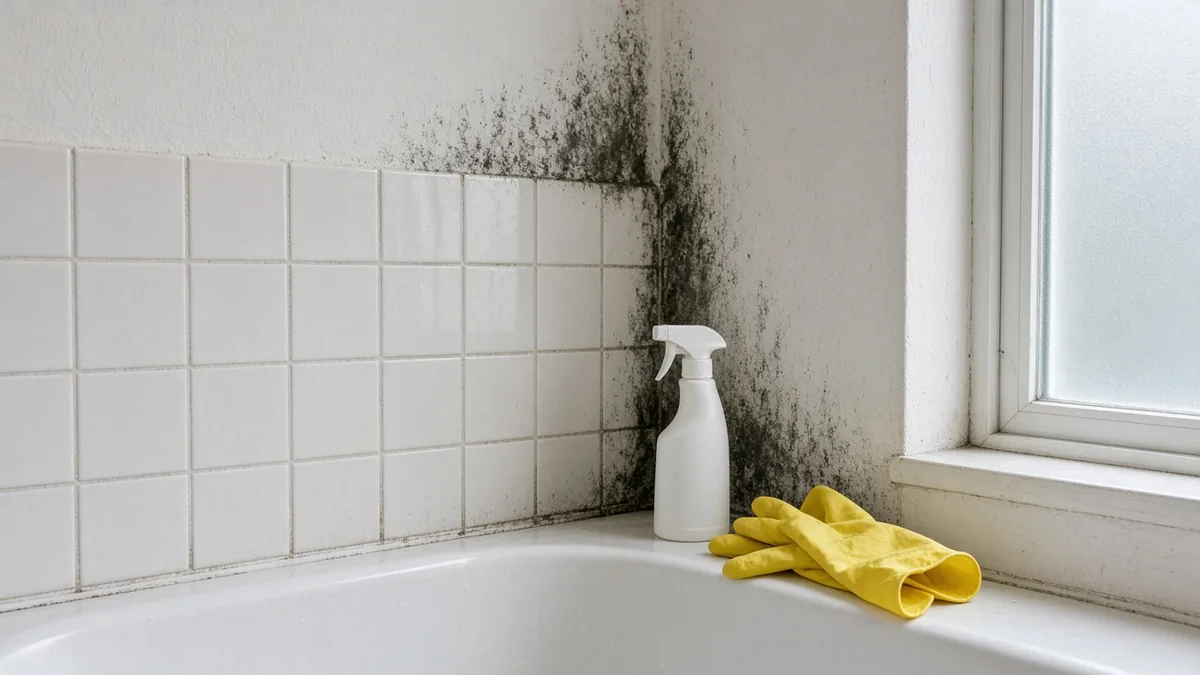
Wear gloves, goggles and a mask over your nose and mouth, open the window but close the door to the rest of the house, then wipe the mould while it is wet using a mould and mildew product (GOV.UK advises these in preference to bleach) and a disposable cloth. Never brush, dry-wipe or vacuum mould. Bag the cloth and mask afterwards, and leave patches larger than about 1 m², or mould caused by leaks, to a professional or your landlord.
A grey-black bloom in the corner of a bathroom ceiling, speckles along a window reveal, a fuzzy patch behind the wardrobe: most British homes see mould at some point. The urge is to grab whatever spray is under the sink and scrub hard. That is exactly how spores end up spread across the room, and in your lungs.
This guide covers the cleaning job itself: protecting yourself, containing spores, choosing a product and knowing when to stop. For why mould grows in the first place, see our guide to why condensation forms on windows.
Why Technique Matters More Than the Product
Mould spreads by releasing spores into the air. NHS inform lists the people most sensitive to damp and mould as babies, children, older people, people with skin problems such as atopic eczema, people with respiratory problems such as allergies and asthma, and people with a weakened immune system. It advises that these groups stay away from damp and mould as much as possible (NHS inform: Damp and mould indoors). Inhaling or touching spores can cause sneezing, a runny nose, red eyes or a skin rash, and mould can trigger asthma attacks.
So if anyone in that list lives with you, ideally someone else should do the cleaning, and the vulnerable person should be out of the room while it happens.
The aim of every step below is the same: get the mould off the wall and into a sealed bag without putting it into the air first.
Step 1: Record It Before You Clean It
GOV.UK's damp and mould guidance suggests photographing the affected area, and if possible drawing around it, before removal (GOV.UK: Understanding and addressing the health risks of damp and mould in the home). A record helps identify the source and plan repairs. If you rent, it is also evidence; our Awaab's Law guide explains why that matters, and you should tell your landlord about the mould even if you clean it yourself.
Take a wide shot showing where the patch is in the room and a close-up showing its extent.
Step 2: Decide Whether This Is a DIY Job
Not every patch is yours to tackle. The WHO Europe brochure on damp and mould, hosted by Wolverhampton Council, suggests that if mould is due to condensation, covers less than 1 m² and is not caused by sewage or other contaminated water, you can probably manage it yourself (WHO Europe: Damp and mould brochure). GOV.UK is clear that while most tenants could reasonably remove condensation and very small amounts of mould, larger areas should only be addressed by qualified professionals.
Stop and get help if:
- The patch is bigger than roughly a metre square, or keeps spreading.
- It appears after a leak, flood, or water coming through the roof or walls.
- It is inside the structure, such as under flooring or behind plasterboard.
- Someone in the household has a respiratory condition or weakened immune system.
Step 3: Get the Right Protective Kit
UK guidance is consistent on the basics. GOV.UK says the person removing mould should wear a mask, gloves and goggles to avoid contact with spores or cleaning products, regardless of the extent of the mould. Energy Saving Trust adds: never touch the mould directly, and wear any other protective equipment the product's manufacturer lists on the label (Energy Saving Trust: How to get rid of damp).
The WHO Europe brochure goes into more detail:
- A mask that covers your nose and mouth.
- Goggles without ventilation holes, so spores cannot reach your eyes.
- Rubber gloves, preferably long ones.
None of the official pages we checked specifies a particular mask grade, so treat the product label as the minimum and go higher if you have any breathing concerns. Wear old clothes you can put straight in the wash afterwards.
Step 4: Ventilate Outwards, Seal Inwards
This step is where many people go wrong. You want spores to leave the house, not drift into the hallway. GOV.UK says doors should be shut to stop spores spreading to other areas, but windows should be left open during and after the clean. Energy Saving Trust gives the same instruction: ventilate with extractor fans or open windows, and keep doors to other rooms closed.
Before you start, have ready:
- A large plastic bag for used cloths, the mask and any mouldy soft items.
- Disposable cloths or rags (more than you think you need).
- A bucket of water and your chosen product.
Step 5: Clean It Wet, Never Dry
Energy Saving Trust is explicit: only wipe mould when it is wet, not when it is dry, to avoid spreading spores into the air. NHBC's condensation leaflet warns against disturbing mould by brushing or vacuum cleaning, because that may release spores that make breathing problems worse (NHBC: Condensation in your home).
A sensible sequence:
- Lightly dampen the mould first so it cannot puff into the air.
- Gently wipe it off with a damp disposable cloth, folding the cloth to a clean face after each pass.
- Apply your mould product and follow the label's instructions, including any contact time it asks for.
- Wipe again with fresh cloths, then dry the surface. GOV.UK says hard surfaces should be left to dry completely.
- Put every used cloth straight into the bag.
Manchester University NHS Foundation Trust's patient leaflet also suggests cleaning at least 1 metre around the visible patch, because growth often extends beyond what you can see (MFT NHS: Damp and mould leaflet).
Choosing a Product: Mould and Mildew Sprays vs Bleach
GOV.UK states that mould and mildew products should be used in preference to bleach, for health and safety reasons. NHS inform adds that if you do use bleach products, you should always open a window. NHBC recommends a fungicidal wash, followed by checking the area for at least a week and repeating if the mould returns. Never mix different cleaning products.
Dedicated sprays in our catalogue include the Dettol Mould & Mildew Remover 500ml at £7.49 and the Astonish Specialist Extra Strength Mould Stain Remover 750ml at £5.84 (Amazon UK prices checked 26/11/2026 06:17 GMT). We have not tested either; check each label for its active ingredients, surface suitability and required protective equipment before you buy. See the full list on our anti-mould treatments page.
Step 6: Clean Up and Deal With Soft Furnishings
GOV.UK says protective equipment and clothing should be washed or carefully disposed of, removed materials should be bagged, and the cloth or sponge should be washed or thrown away. West Lindsey District Council's tenant guide suggests binning the cloth and mask, and cleaning gloves and goggles in soapy water afterwards.
Absorbent items are harder. GOV.UK notes that carpets, soft furnishings and ceiling tiles may have to be thrown away if mouldy, because it may be difficult or impossible to remove the mould completely. NHBC suggests dry cleaning mouldy clothing or carpets.
When redecorating, NHBC suggests a good-quality fungicidal paint, but warns it will not work if later covered with ordinary paint or wallpaper.
Step 7: Stop It Coming Back
Cleaning treats the symptom. GOV.UK stresses that tenant management of condensation and small amounts of mould should not be a substitute for addressing the underlying issue. Energy Saving Trust says the same: to truly get rid of damp you need to address the root cause, whether that is rain getting in, a plumbing leak, rising damp or condensation.
If the cause is condensation, three habits make the biggest difference:
- Measure. A ThermoPro TP50 hygrometer (£7.99, checked 26/11/2026 06:17 GMT) shows whether the room's humidity is staying high after showers or overnight.
- Ventilate. Energy Saving Trust advises running extractor fans for at least 15 minutes after a shower or bath and keeping trickle vents open.
- Dehumidify where needed. In a bathroom-adjacent bedroom or hallway, a quiet compressor unit such as the MeacoDry Arete One 12L (151 W, 35 dB) costs about 3.97p per hour at the Ofgem cap of 26.32p/kWh for 1 October to 31 December 2026 (Ofgem). Our black mould bathroom picks compare suitable models.
Quick Safety Checklist
- Photograph the patch first.
- Check it is under about 1 m² and caused by condensation, not a leak.
- Gloves, goggles and a nose-and-mouth mask on; vulnerable people out of the room.
- Window open, internal door shut.
- Damp the mould, wipe gently, never brush, dry-wipe or vacuum it.
- Bag cloths and mask, wash clothes and kit.
- Fix the moisture source, or report it to your landlord.
Recommended In-Stock Models & Running Costs
Only models currently in stock on Amazon UK are shown below. Adjust the electricity rate to match your tariff.
| Model | Category | Power | Cost / hr | 8h Cycle | Amazon UK Price | Action |
|---|---|---|---|---|---|---|
| Mould Sprays | — | — | — | £7.49 90-DAY LOW Price accurate as of 28/11/2026 04:49 GMT | Check price on Amazon | |
| Mould Sprays | — | — | — | £6.49 Price accurate as of 28/11/2026 04:49 GMT | Check price on Amazon | |

Meaco MeacoDry Arete One 12L Dehumidifier / Air Purifier
12L/day
·
35 dB
|
Compressors | 151 W | 3.97p/hr | £0.32 | £179.99 90-DAY LOW Price accurate as of 28/11/2026 04:49 GMT | Check price on Amazon |
| Hygrometers | — | — | — | £7.99 90-DAY LOW Price accurate as of 28/11/2026 04:49 GMT | Check price on Amazon |


Product prices and availability are accurate as of the date/time indicated and are subject to change. Any price and availability information displayed on Amazon.co.uk at the time of purchase will apply to the purchase of this product.
Frequently Asked Questions
Can I just use bleach on black mould?
GOV.UK guidance for landlords and tenants says mould and mildew products should be used in preference to bleach, for health and safety reasons. NHS inform adds that you should always open a window if you are using bleach products. Whatever you use, read the label: many sprays sold for mould list their own active ingredients and protective equipment requirements.
What kind of mask do I need to clean mould?
The UK guidance we checked asks for a mask that covers your nose and mouth, plus gloves and goggles, but does not name a specific filter grade. The WHO Europe brochure published by Wolverhampton Council recommends goggles without ventilation holes and long rubber gloves. Always also follow any extra protective equipment the cleaning product's label specifies.
How big a patch of mould can I clean myself?
The WHO Europe brochure suggests a household can probably manage condensation mould covering less than 1 m² (about 1 metre by 1 metre), provided it is not caused by sewage or other contaminated water. GOV.UK says larger areas should only be tackled by qualified professionals, and mould linked to leaks or building faults needs the cause fixed first.
Why does black mould keep coming back after I clean it?
Because cleaning removes the growth, not the moisture that fed it. Energy Saving Trust and GOV.UK both stress fixing the underlying cause, whether that is condensation, a leak or rising damp. Track humidity with a hygrometer and reduce it with ventilation or a dehumidifier, otherwise the same spot will grow mould again.
More UK Damp & Running-Cost Guides
Why Condensation Forms on the Inside of UK Windows (Dew Point Explained)
Condensation forms on the inside of a window when the glass is colder than the dew point of the room air, so water vapour turns back into droplets on it. At 20°C and 60% relative humidity the dew point is roughly 12°C, so any pane or frame colder than about 12°C will mist up. Bringing the dew point down (less moisture, more ventilation, a dehumidifier) or warming the glass is the only way to stop it.
New-Build Homes in the UK: Drying Out Construction Moisture in Year One
NHBC says up to 8,000 litres of water can go into building a new home, and that a new home should reach a moisture-balanced state within 18 months to 2 years. Because modern homes are insulated and draught-proofed, that moisture and everyday steam escape slowly, so keep trickle vents open, run extractors, heat evenly rather than hot, avoid drying clothes on radiators, and use a dehumidifier if condensation persists. Ongoing damp or mould is not normal and should be reported to your builder.
Compressor vs Desiccant Dehumidifier: Which Works Best in British Homes?
Choose by room temperature: Meaco's rule of thumb is a desiccant below 10°C, a desiccant or large 20L–25L compressor between 10°C and 15°C, and any type above 15°C. Compressors are generally cheaper to run in heated homes (the in-stock 12L models in our dataset draw 151–200 W), while desiccants keep working in cold garages and conservatories (our desiccant models are rated from 1°C) and blow out noticeably warmer air.