
Why Condensation Forms on the Inside of UK Windows (Dew Point Explained)
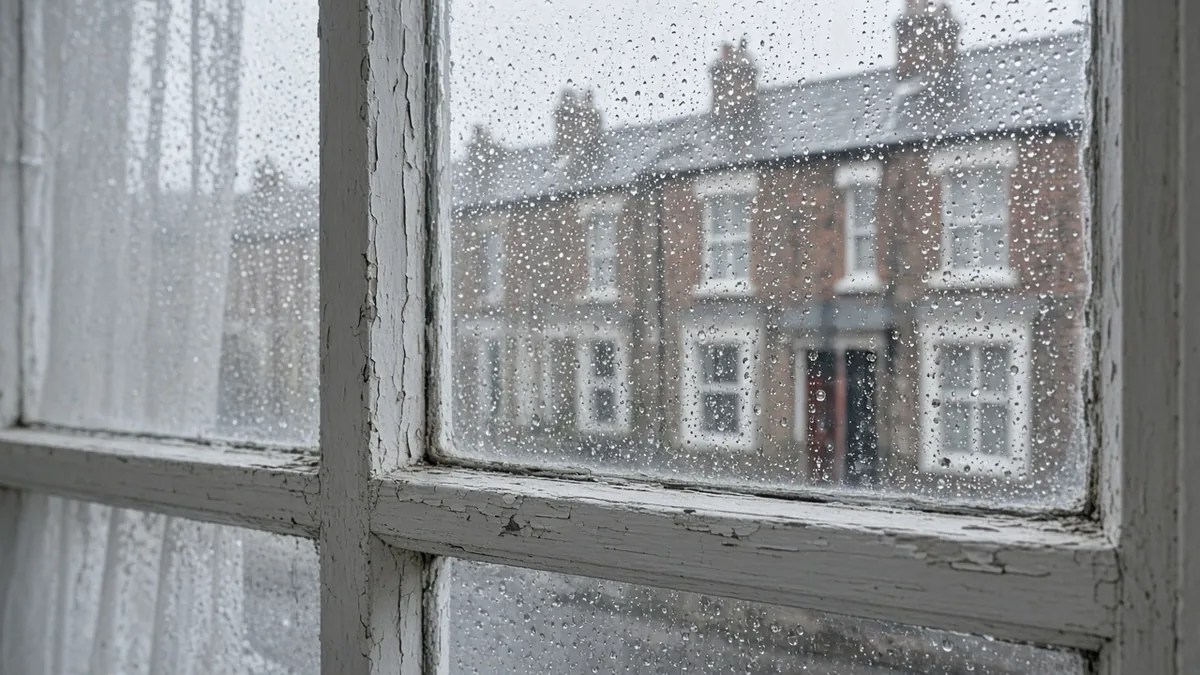
Condensation forms on the inside of a window when the glass is colder than the dew point of the room air, so water vapour turns back into droplets on it. At 20°C and 60% relative humidity the dew point is roughly 12°C, so any pane or frame colder than about 12°C will mist up. Bringing the dew point down (less moisture, more ventilation, a dehumidifier) or warming the glass is the only way to stop it.
If you live in Britain, you have probably woken on a November morning to bedroom windows streaming with water, a damp line along the bottom of the frame and a puddle on the sill. It looks as though water is leaking in from outside, but almost all of it came from inside the room. The explanation is a single number meteorologists use every day: the dew point.
This guide explains what the dew point is, why window glass is the first surface to cross it, and how a cheap hygrometer lets you predict and prevent the problem rather than mopping up after it. It deliberately does not cover condensation trapped between double-glazed panes, which is a sealed-unit fault rather than an indoor humidity issue.
What the Dew Point Actually Is
The Met Office defines the dew point as the temperature at which condensation occurs, and notes that it depends on the humidity and pressure of the air (Met Office: Dew). When a surface cools to below the dew point of the air touching it, water vapour condenses into droplets on that surface. Outdoors, that is the dew on your lawn. Indoors, it is the water on your windows.
Two related measures matter here:
- Relative humidity (RH) tells you how close the air is to saturation at its current temperature, as a percentage.
- Dew point tells you how cold a surface has to be before that air deposits water on it.
The Met Office's climate dashboard puts the link neatly: the closer the dew point temperature is to the air temperature, the higher the relative humidity (Met Office Climate Dashboard: Humidity). At 100% RH the two are equal, and condensation forms on everything.
Why Windows Are Always the First Surface to Get Wet
Inside a heated home, nearly every surface sits close to room temperature: plastered walls, furniture, the ceiling. Windows are the exception. Glass and frames are thin compared with a wall, so on a cold night their inner face cools towards the outdoor temperature far more than the plaster beside them.
That makes the window your home's built-in condensation alarm. Energy Saving Trust explains that moisture in the air forms condensation when it hits a cold surface, like a window, and lists excessive condensation around windows as one of the main signs of damp (Energy Saving Trust: How to get rid of damp). The same physics then works its way to the next-coldest spots: external corners, window reveals, the wall behind a wardrobe, and anywhere insulation has a gap.
The 6am effect
Condensation peaks early in the morning for three overlapping reasons:
- Outdoor temperatures are usually lowest around dawn, so the glass is at its coldest.
- Heating is often off or turned down overnight, so room air and surfaces cool too.
- Occupants have been breathing all night in a closed room. NHBC's Moisture in New Homes guide estimates breathing alone adds around 550 litres of moisture a year for a working couple, rising to 1,110 litres a year for a family of four with teenagers (NHBC: Moisture in New Homes). For the couple, that works out at roughly 1.5 litres a day.
By 6am, the bedroom air has more moisture in it than at bedtime, while the glass is colder than at any other point in the day.
A Worked Dew Point Table for British Rooms
The table below uses the standard Magnus approximation to convert room temperature and RH into a dew point. Values are rounded to 0.1°C; treat them as a guide, since a ±3% RH hygrometer error moves the result by roughly half a degree to a degree.
| Room air | 50% RH | 60% RH | 70% RH | 80% RH |
|---|---|---|---|---|
| 16°C (cool bedroom) | 5.6°C | 8.2°C | 10.5°C | 12.5°C |
| 18°C | 7.4°C | 10.1°C | 12.4°C | 14.5°C |
| 20°C (heated living room) | 9.3°C | 12.0°C | 14.4°C | 16.4°C |
| 21°C | 10.2°C | 12.9°C | 15.3°C | 17.4°C |
Read it like this: in a 16°C bedroom at 70% RH, any surface colder than about 10.5°C will collect water. On a frosty night, the inner face of older glazing or an aluminium frame can easily be colder than that. Drop the same room to 50% RH and the glass now has to fall below about 5.6°C before it mists.
Two practical lessons follow:
- Small RH reductions buy a lot of protection. In a 20°C room, going from 70% to 60% RH lowers the dew point by more than two degrees.
- Cool rooms are more vulnerable. The same amount of moisture produces a higher RH in colder air, which is why unheated spare rooms and north-facing bedrooms tend to be the wettest.
How to Diagnose Your Own Windows With a Hygrometer
You cannot judge humidity by feel. A digital thermo-hygrometer costs less than a takeaway and turns guesswork into numbers you can act on. In our catalogue, the ThermoPro TP50 is listed at £7.99, the Bluetooth Govee H5075 at £9.48 and the Wi-Fi Govee H5179 at £16.99 (Amazon UK prices checked 26/11/2026 06:17 GMT). Govee's UK pages quote humidity accuracy of around 3% RH for both models, and the H5075 keeps 20 days of history on the device, which is handy for spotting overnight patterns. Browse all options on our hygrometers page.
A simple three-night routine:
- Place the hygrometer at bed height, away from the window and radiator, and not in direct sunlight.
- Note temperature and RH at bedtime and on waking, along with whether the trickle vents were open, the door was shut, or washing was drying indoors.
- Look up the dew point in the table above and compare it with how wet the glass was.
If the morning RH is regularly in the high 60s or above with the door closed, the room is generating more moisture than it can get rid of. If RH is moderate but one window still streams, that pane or frame is unusually cold, so look at the glazing, the seals and whether curtains are trapping cold air against the glass.
What Actually Lowers the Dew Point
There are only two levers: take moisture out of the air, or keep surfaces warmer. Everything else is a variation on those.
Remove or vent moisture at source
Energy Saving Trust's prevention list is the best starting point: keep trickle vents open and unobstructed, open windows several times a day for at least five minutes, run bathroom and cooker extractors for at least 15 minutes after use, put lids on pans, and dry clothes outside when the weather allows (Energy Saving Trust). If you dry laundry indoors, our comparison of heated airers, dehumidifiers and tumble dryers shows where each method sends that water.
Wipe the glass, don't let it re-evaporate
NHBC advises wiping condensation away as soon as it appears (NHBC: Condensation in your home). Left alone, the water simply evaporates back into the room and contributes to the next night's condensation. A cloth wrung out in the sink works; a window vac such as the Kärcher WV 1 (£24.99, checked 26/11/2026 06:17 GMT; Amazon lists a 100 ml dirty-water tank and 20-minute run time) makes it quicker if you have several large panes.
Run a dehumidifier in the problem room
A dehumidifier pulls the RH down directly, which drags the dew point down with it. For a bedroom, noise matters as much as capacity: the MeacoDry Arete Two 12L is listed at 35 dB and 155 W, which works out at about 4.08p per hour at the Ofgem cap of 26.32p/kWh for 1 October to 31 December 2026 (Ofgem). Our running cost guide has the full pence-per-hour table, and our quiet bedroom dehumidifier picks compare noise levels. If the room is cold, read our compressor vs desiccant guide before you buy.
Keep surfaces warmer
NHBC notes that homes heated irregularly are more likely to have condensation than those heated continuously, because continuous heating keeps room surfaces warm. Energy Saving Trust adds that leaving the heating on all the time just to avoid damp is not sensible, so the goal is even, moderate warmth rather than blasting the radiators. Open curtains and blinds in the morning so the glass is not cut off from the room's warm air.
When Window Condensation Is a Warning Sign
Treat condensation as more than a nuisance if you see:
- Water pooling on sills every morning, or the window seal and frame starting to blacken.
- Black mould on reveals, corners or behind furniture on outside walls.
- Condensation on walls or ceilings rather than just glass.
- Damp that gets worse when it rains, which suggests penetrating damp rather than condensation.
Older solid-wall homes are especially prone to cold surfaces; see our Victorian terrace dehumidifier guide. If mould has already appeared, follow our safe black mould cleaning guide, and if you rent, our Awaab's Law guide explains how to use your hygrometer readings as evidence.
The Bottom Line
Inside condensation is not a mystery: it is warm, moist room air meeting glass that is colder than its dew point. Measure the RH, look up the dew point, and then either lower the moisture or warm the surface. A £8 to £17 hygrometer tells you which lever to pull, and in most British homes the answer is a combination of ventilation, wiping and, where needed, a quiet dehumidifier.
Recommended In-Stock Models & Running Costs
Only models currently in stock on Amazon UK are shown below. Adjust the electricity rate to match your tariff.
| Model | Category | Power | Cost / hr | 8h Cycle | Amazon UK Price | Action |
|---|---|---|---|---|---|---|
| Hygrometers | — | — | — | £7.99 90-DAY LOW Price accurate as of 28/11/2026 04:49 GMT | Check price on Amazon | |
| Hygrometers | — | — | — | £9.48 90-DAY LOW Price accurate as of 28/11/2026 04:49 GMT | Check price on Amazon | |
| Hygrometers | — | — | — | £16.99 90-DAY LOW Price accurate as of 28/11/2026 04:49 GMT | Check price on Amazon | |
| Window Vacs | — | — | — | £24.99 90-DAY LOW Price accurate as of 28/11/2026 04:49 GMT | Check price on Amazon | |

Meaco MeacoDry Arete Two 12L Dehumidifier / Air Purifier
12L/day
·
35 dB
|
Compressors | 155 W | 4.08p/hr | £0.33 | £199.99 90-DAY LOW Price accurate as of 28/11/2026 04:49 GMT | Check price on Amazon |


Product prices and availability are accurate as of the date/time indicated and are subject to change. Any price and availability information displayed on Amazon.co.uk at the time of purchase will apply to the purchase of this product.
Frequently Asked Questions
Is a little condensation on my windows in the morning normal?
Usually, yes. Energy Saving Trust says most homes see condensation on windows from time to time, for example on a cold morning, and that it is not necessarily a problem if it clears quickly. It becomes a concern when it is heavy every day, runs onto sills and frames, or is joined by black mould, peeling paint or musty smells.
Why are my bedroom windows wetter than the rest of the house?
Bedrooms are often kept cooler than living rooms and have their doors shut overnight, while one or two people breathing for eight hours add moisture to a small volume of air. The relative humidity climbs, the dew point rises, and the glass, which is the coldest surface in the room, crosses below it first.
What humidity should I aim for to stop window condensation?
There is no single magic number, because it depends on how cold your glass gets. Use the dew point table in this guide: at 20°C, dropping from 70% to 55% RH lowers the dew point from about 14.4°C to about 10.7°C, which means the glass has to be much colder before it mists. Measure, then aim to keep the dew point below your coldest surface.
Should I wipe condensation off or leave it to evaporate?
Wipe it off. Leaving it to evaporate simply puts the same water back into the room air, where it can condense again elsewhere. NHBC's condensation guidance advises wiping condensation away as soon as possible; a cloth you wring out in the sink, or a window vac, removes the water from the room for good.
More UK Damp & Running-Cost Guides
How to Clean Black Mould Safely Without Spreading Spores Around Your Home
Wear gloves, goggles and a mask over your nose and mouth, open the window but close the door to the rest of the house, then wipe the mould while it is wet using a mould and mildew product (GOV.UK advises these in preference to bleach) and a disposable cloth. Never brush, dry-wipe or vacuum mould. Bag the cloth and mask afterwards, and leave patches larger than about 1 m², or mould caused by leaks, to a professional or your landlord.
New-Build Homes in the UK: Drying Out Construction Moisture in Year One
NHBC says up to 8,000 litres of water can go into building a new home, and that a new home should reach a moisture-balanced state within 18 months to 2 years. Because modern homes are insulated and draught-proofed, that moisture and everyday steam escape slowly, so keep trickle vents open, run extractors, heat evenly rather than hot, avoid drying clothes on radiators, and use a dehumidifier if condensation persists. Ongoing damp or mould is not normal and should be reported to your builder.
Compressor vs Desiccant Dehumidifier: Which Works Best in British Homes?
Choose by room temperature: Meaco's rule of thumb is a desiccant below 10°C, a desiccant or large 20L–25L compressor between 10°C and 15°C, and any type above 15°C. Compressors are generally cheaper to run in heated homes (the in-stock 12L models in our dataset draw 151–200 W), while desiccants keep working in cold garages and conservatories (our desiccant models are rated from 1°C) and blow out noticeably warmer air.